
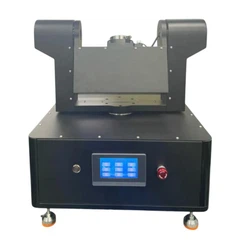
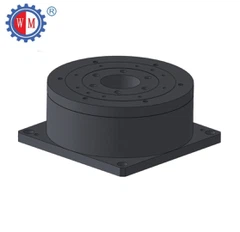
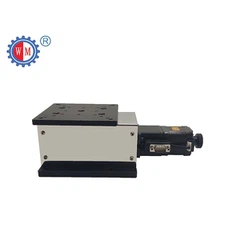
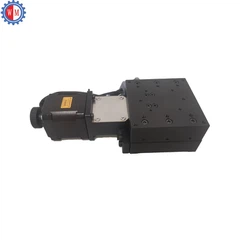
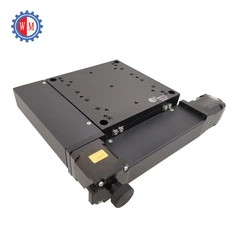
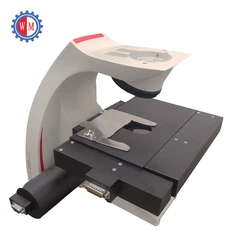
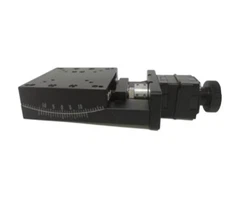
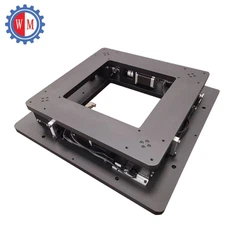
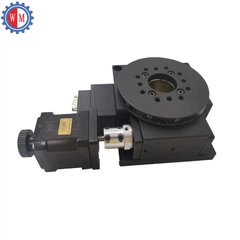
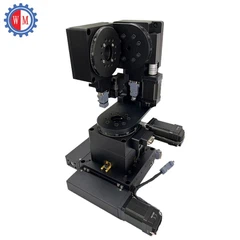
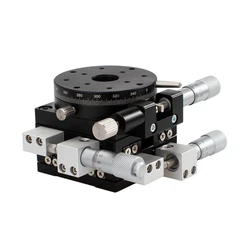
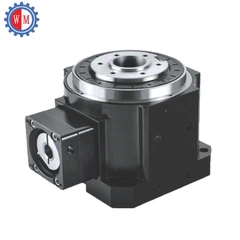
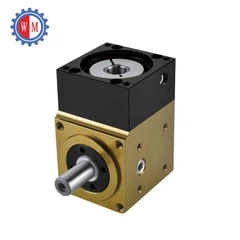


As a supplier of Motorized Rotary Tables, I often encounter customers who are curious about various technical aspects of our products. One question that frequently comes up is: What is the static friction of a motorized rotary table? In this blog post, I'll delve into this topic, explaining what static friction is, why it matters in the context of motorized rotary tables, and how it impacts the performance of our products.
Understanding Static Friction
Static friction is a fundamental concept in physics. It refers to the force that resists the initiation of motion between two surfaces in contact when they are at rest relative to each other. In simpler terms, it's the force you need to overcome to start moving an object that's sitting still on a surface.


The magnitude of static friction depends on two main factors: the nature of the surfaces in contact and the normal force pressing the two surfaces together. The nature of the surfaces is characterized by a coefficient of static friction, denoted as μs. This coefficient is a dimensionless number that represents the ratio of the maximum static frictional force to the normal force.
Mathematically, the maximum static frictional force (Fs) can be calculated using the formula:
Fs = μs * N
where N is the normal force.
Static Friction in Motorized Rotary Tables
In the context of motorized rotary tables, static friction plays a crucial role in ensuring precise and stable operation. A motorized rotary table is a device that rotates a workpiece or instrument around a central axis. It is commonly used in various industries, such as manufacturing, automation, and research, for tasks like precision machining, inspection, and testing.
1. Positioning Accuracy
One of the primary functions of a motorized rotary table is to accurately position the workpiece at a specific angle. Static friction helps maintain the table's position when it's not in motion. When the motor stops rotating, the static friction between the rotating components (such as the worm gear and the table) prevents the table from drifting or moving due to external forces, such as vibrations or minor shocks. This ensures that the workpiece remains in the desired position, which is essential for achieving high-precision results.
2. Torque Requirements
The static friction also affects the torque requirements of the motor. To start rotating the table from a stationary position, the motor needs to generate enough torque to overcome the static friction. If the static friction is too high, the motor may struggle to start the rotation, leading to slow or inconsistent movement. On the other hand, if the static friction is too low, the table may be prone to unwanted movement or slipping, which can also affect the accuracy of the positioning.
3. Wear and Tear
Proper management of static friction can also reduce wear and tear on the motorized rotary table. When the static friction is within the optimal range, the components experience less stress and friction during operation, which can extend the lifespan of the table and reduce the need for frequent maintenance.
Factors Affecting Static Friction in Motorized Rotary Tables
Several factors can influence the static friction of a motorized rotary table. Here are some of the key factors:
1. Surface Finish
The surface finish of the rotating components, such as the worm gear and the table, can have a significant impact on the static friction. A smooth surface finish generally results in lower static friction, while a rough surface finish can increase the friction. However, it's important to note that a surface that is too smooth may also reduce the grip between the components, leading to slipping. Therefore, a balance needs to be struck to achieve the optimal surface finish for the specific application.
2. Lubrication
Lubrication is another important factor that affects static friction. Applying a suitable lubricant between the rotating components can reduce the friction and wear, making it easier for the motor to start and stop the rotation. However, the type and amount of lubricant need to be carefully selected to ensure that it doesn't cause any issues, such as contamination or reduced friction in the long term.
3. Load
The load placed on the motorized rotary table can also affect the static friction. As the load increases, the normal force between the rotating components also increases, which in turn increases the static friction. Therefore, when selecting a motorized rotary table, it's important to consider the maximum load that the table will need to support and ensure that the motor has enough torque to overcome the static friction under the expected load conditions.
Our Motorized Rotary Table Products and Static Friction
At our company, we offer a range of high-quality motorized rotary tables that are designed to provide precise and reliable performance. Our products are engineered with careful consideration of static friction to ensure optimal operation in various applications.
For example, our Motorized Rotary Stage with Worm Gear Device features a high-precision worm gear mechanism that provides excellent static friction characteristics. The worm gear design ensures smooth and stable rotation, while the static friction helps maintain the table's position accurately.
We also offer Servo Motor Rotary Stage and Worm Gear Precision Rotation Stage, which are designed to meet the specific needs of different applications. These stages are equipped with advanced motors and control systems that are optimized to work in conjunction with the static friction of the table, providing precise positioning and high-speed operation.
Conclusion
In conclusion, static friction is a critical factor in the operation of motorized rotary tables. It affects the positioning accuracy, torque requirements, and wear and tear of the table. By understanding the concept of static friction and its role in motorized rotary tables, customers can make informed decisions when selecting a product that meets their specific needs.
If you're interested in learning more about our motorized rotary tables or have any questions regarding static friction or other technical aspects, please feel free to contact us. We're always happy to assist you with your procurement needs and provide you with the best solutions for your applications.
References
- Halliday, D., Resnick, R., & Walker, J. (2014). Fundamentals of Physics. Wiley.
- Shigley, J. E., & Mischke, C. R. (2003). Mechanical Engineering Design. McGraw-Hill.


