
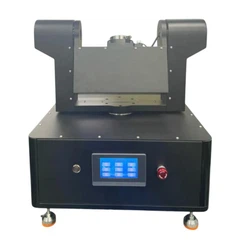
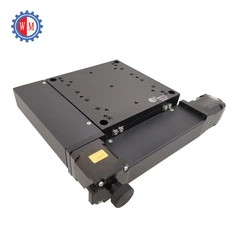
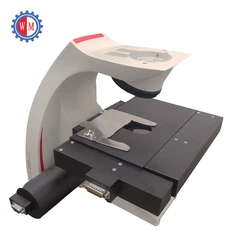
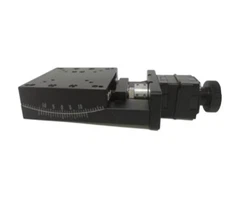
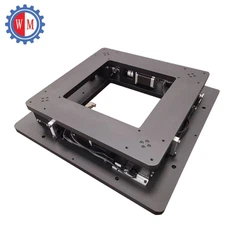
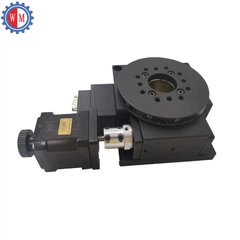
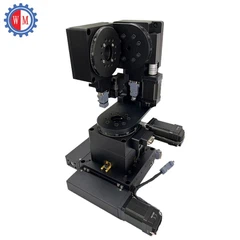
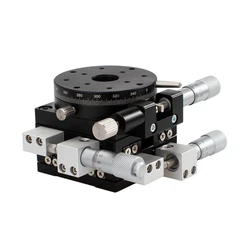
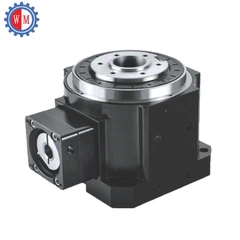


As a supplier of manual stages, I understand the critical importance of accurately measuring the performance of these precision instruments. Manual stages are widely used in various fields such as microscopy, optical alignment, and semiconductor manufacturing, where precise positioning is essential. In this blog post, I will share some key methods and parameters for measuring the performance of manual stages to help you make informed decisions when selecting and using these products.
1. Positioning Accuracy
Positioning accuracy is one of the most important performance indicators of a manual stage. It refers to the ability of the stage to move to a specified position within a certain tolerance range. To measure the positioning accuracy, we can use a coordinate measuring machine (CMM) or a laser interferometer.
-
Coordinate Measuring Machine (CMM): A CMM is a precision measuring device that can measure the three - dimensional coordinates of points on an object. To measure the positioning accuracy of a manual stage using a CMM, we first need to establish a measurement coordinate system. Then, we move the stage to a series of pre - defined positions and measure the actual positions using the CMM. The difference between the actual positions and the target positions is the positioning error. By repeating this process multiple times at different positions on the stage, we can calculate the average positioning error and the maximum positioning error.
-
Laser Interferometer: A laser interferometer is a highly accurate measuring instrument that uses the interference of laser light to measure small displacements. When measuring the positioning accuracy of a manual stage with a laser interferometer, a laser beam is directed onto a mirror attached to the stage. As the stage moves, the interference pattern of the laser light changes, and the displacement of the stage can be accurately measured. Similar to the CMM method, we can move the stage to different target positions and record the actual displacements to calculate the positioning accuracy.
2. Repeatability
Repeatability is another crucial performance parameter of manual stages. It indicates the ability of the stage to return to the same position repeatedly. Good repeatability ensures that the stage can perform consistent operations over multiple cycles.
To measure the repeatability, we can use the following steps:
- Select a set of target positions on the stage.
- Move the stage to each target position multiple times (usually at least 10 times).
- Measure the actual positions of the stage each time it reaches the target position.
- Calculate the standard deviation of the measured positions for each target position. The smaller the standard deviation, the better the repeatability of the stage.
For example, if we have a target position (X = 10 mm, Y = 20 mm) on the stage, and we move the stage to this position 10 times. The measured X - coordinates are (X_1,X_2,\cdots,X_{10}) and the measured Y - coordinates are (Y_1,Y_2,\cdots,Y_{10}). The standard deviation of the X - coordinates (\sigma_X=\sqrt{\frac{1}{n - 1}\sum_{i = 1}^{n}(X_i-\bar{X})^2}), where (\bar{X}=\frac{1}{n}\sum_{i = 1}^{n}X_i) and (n = 10). Similarly, we can calculate the standard deviation of the Y - coordinates (\sigma_Y).
3. Resolution
Resolution refers to the smallest increment of movement that a manual stage can achieve. It is determined by the mechanical design of the stage, such as the pitch of the lead screw and the quality of the motion control mechanism.
To measure the resolution of a manual stage, we can use a high - precision displacement sensor. We gradually increase the input to the stage's motion control mechanism (e.g., turning the micrometer knob) and record the corresponding displacements of the stage. The smallest detectable displacement change is the resolution of the stage.
For example, if we use a linear encoder with a resolution of 1 µm to measure the displacement of the stage, and we find that the smallest displacement change that can be consistently achieved when turning the micrometer knob is 5 µm, then the resolution of the stage is 5 µm.
4. Load Capacity
Load capacity is an important consideration, especially when the manual stage is used to carry heavy objects. It refers to the maximum weight that the stage can support without significantly affecting its performance.
To measure the load capacity, we can gradually increase the load on the stage while monitoring its performance parameters such as positioning accuracy, repeatability, and smoothness of movement. When the performance of the stage starts to degrade beyond an acceptable level, the corresponding load is considered the load capacity of the stage.
For instance, we can start with a small load (e.g., 1 kg) and measure the positioning accuracy and repeatability of the stage. Then, we increase the load by 1 kg at a time and repeat the measurements. If we find that when the load reaches 5 kg, the positioning error increases from 10 µm to 30 µm, which is beyond our acceptable tolerance, then the load capacity of the stage is approximately 5 kg.
5. Smoothness of Movement
The smoothness of movement affects the ease of operation and the accuracy of the stage. A stage with smooth movement can reduce the risk of jerks or vibrations during operation, which may cause errors in positioning.
To evaluate the smoothness of movement, we can use a vibration sensor or simply observe the movement of the stage by eye. A vibration sensor can detect any sudden changes in acceleration during the movement of the stage. If the vibration level is within an acceptable range (usually specified by the manufacturer), the movement of the stage is considered smooth.
When observing the movement by eye, we can look for any visible jerks, stutters, or unevenness in the motion of the stage as we turn the micrometer knobs. If the movement appears to be continuous and fluid, the stage has good smoothness of movement.
6. Influence of Environmental Factors
Environmental factors such as temperature, humidity, and vibration can also affect the performance of manual stages.
- Temperature: Temperature changes can cause thermal expansion or contraction of the stage components, which may lead to changes in positioning accuracy and repeatability. To study the influence of temperature, we can place the stage in a temperature - controlled chamber and measure its performance at different temperatures. For example, we can measure the positioning accuracy of the stage at 20°C, 30°C, and 40°C to see how the performance changes with temperature.
- Humidity: High humidity can cause corrosion of the stage components, which may affect the smoothness of movement and the overall performance of the stage. We can expose the stage to different humidity levels in a humidity - controlled environment and monitor its performance over time.
- Vibration: External vibrations can interfere with the movement of the stage and reduce its positioning accuracy. To measure the influence of vibration, we can place the stage on a vibration - isolation table and compare its performance with the performance when the stage is placed on a normal workbench.
When selecting a manual stage, it is important to consider the environmental conditions in which the stage will be used and choose a stage that can withstand these conditions. For example, if the stage will be used in a high - temperature environment, we should choose a stage made of materials with low thermal expansion coefficients.
7. Compatibility with Accessories
In many applications, manual stages need to be used in conjunction with other accessories such as Aluminum Optical Breadboard. The compatibility of the stage with these accessories is also an important aspect of performance evaluation.
We need to ensure that the mechanical interfaces of the stage and the accessories are compatible, so that they can be easily assembled and disassembled. In addition, the combined system should not cause any interference or degradation in the performance of the stage or the accessories.
For example, if we want to use an aluminum optical breadboard with a manual stage, we need to check if the mounting holes on the stage match the holes on the breadboard. We also need to ensure that the weight of the breadboard does not exceed the load capacity of the stage.


Conclusion
Accurately measuring the performance of manual stages is essential for ensuring their proper use in various applications. By evaluating parameters such as positioning accuracy, repeatability, resolution, load capacity, smoothness of movement, and considering the influence of environmental factors and compatibility with accessories, we can select the most suitable manual stage for our needs.
If you are interested in our manual stage products or have any questions about performance measurement and selection, please feel free to contact us for further discussion and procurement negotiation. We are committed to providing high - quality manual stages and professional technical support to meet your requirements.
References
- "Precision Motion Control Handbook" by Peter R. C. Gomm
- "Optical Metrology" by Rudolf Dändliker


