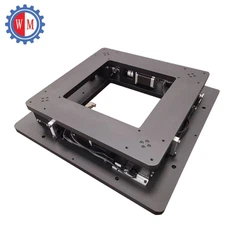
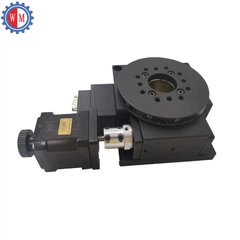
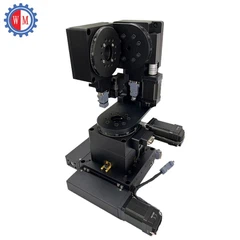
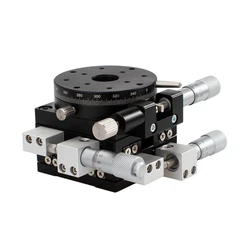


Hey there! As a supplier of Motorized 2 Axis Stages, I often get asked about the maximum acceleration time of these nifty devices. So, I thought I'd take a few minutes to break it down for you in this blog post.
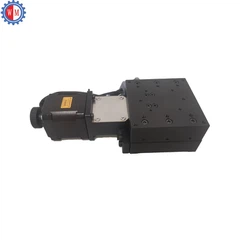
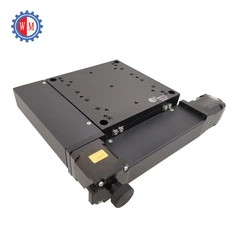
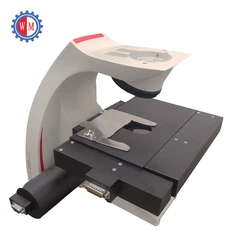
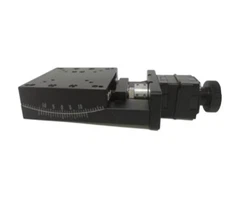
First off, let's talk about what motorized 2 axis stages are. They're basically precision positioning systems that can move in two directions - usually the X and Y axes. These stages are used in a wide range of applications, from microscopy and semiconductor manufacturing to laser processing and optical testing. They're super handy because they allow for accurate and repeatable movement, which is crucial in many industries.
Now, the maximum acceleration time of motorized 2 axis stages can vary quite a bit depending on a few different factors. One of the biggest factors is the type of motor being used. There are two main types of motors commonly used in these stages: stepper motors and servo motors.
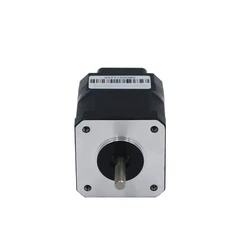
Stepper motors are a popular choice because they're relatively inexpensive and easy to control. They work by moving in discrete steps, which means they can provide precise positioning. However, they have some limitations when it comes to acceleration. Stepper motors typically have a lower maximum acceleration compared to servo motors. This is because they rely on the magnetic fields in the motor to move, and there's a limit to how quickly these fields can change.


On the other hand, servo motors are more expensive but offer better performance. They use a feedback system to continuously adjust the motor's position, which allows for smoother and faster movement. Servo motors can achieve much higher maximum accelerations than stepper motors, making them a great choice for applications that require rapid movement.
Another factor that affects the maximum acceleration time is the load on the stage. If you're moving a heavy object, the stage will need more time to accelerate. This is because the motor has to overcome the inertia of the load. So, if you're planning to use your motorized 2 axis stage to move a large or heavy object, you'll need to take this into account when considering the maximum acceleration time.
The design of the stage itself also plays a role. Stages with a more rigid structure can generally handle higher accelerations without experiencing excessive vibration or deflection. This is important because vibration can affect the accuracy of the positioning, and deflection can cause the stage to move out of alignment.
Let's take a closer look at how these factors interact. For example, if you're using a stepper motor on a stage with a relatively light load and a rigid design, you might be able to achieve a maximum acceleration time of around 0.1 to 0.2 seconds. However, if you're using a servo motor on the same stage, you could potentially reduce that time to as little as 0.05 seconds or even less.
But what if you have a heavy load? Well, in that case, even a servo motor might struggle to achieve a very short acceleration time. You might find that the maximum acceleration time increases to 0.3 seconds or more, depending on the weight of the load.
It's also worth noting that the maximum acceleration time is not the only important factor to consider. You also need to think about the maximum speed and the accuracy of the stage. These three factors - acceleration time, maximum speed, and accuracy - are all interrelated, and you'll need to find the right balance for your specific application.
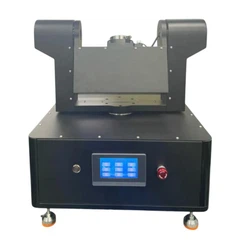
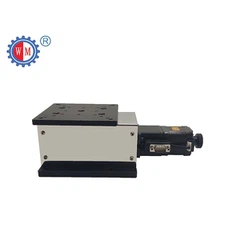
If you're in the market for a motorized 2 axis stage, I'd recommend checking out our Motorized Xy Translation Stage. It's a high-quality stage that offers excellent performance and reliability. We also have a great selection of Motorized Xy Linear Stage options, as well as Motorized XY Tables Built-in Controllers for added convenience.
When you're choosing a stage, make sure to consider your specific requirements. Think about the load you'll be moving, the speed and accuracy you need, and the budget you have. If you have any questions or need help choosing the right stage for your application, don't hesitate to reach out. We're here to help you make the best decision for your needs.
In conclusion, the maximum acceleration time of motorized 2 axis stages depends on several factors, including the type of motor, the load on the stage, and the design of the stage itself. By understanding these factors, you can make an informed decision when choosing a stage for your application. And if you're looking for a reliable supplier of motorized 2 axis stages, look no further. We've got the expertise and the products to meet your needs. So, why not get in touch today and start discussing your requirements? We're eager to work with you and help you find the perfect solution for your project.
References:
- General knowledge of motorized stage technology and industry standards.


