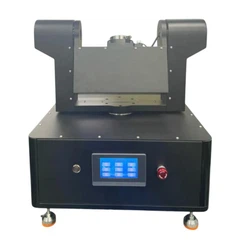
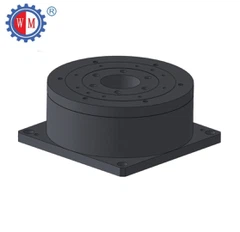
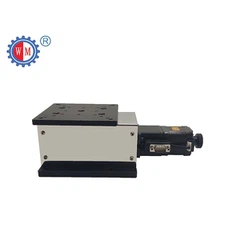
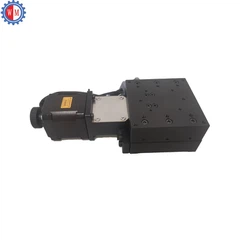
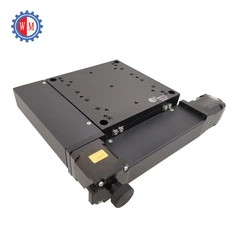
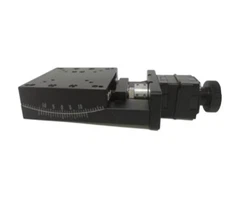


As a provider of Manual Multi - Axis Stages, I am frequently asked about the training contents necessary for effectively using these precision instruments. Manual multi - axis stages are essential in various fields such as microscopy, photonics, and semiconductor manufacturing, where precise positioning is crucial. In this blog, I will delve into the key training contents for using manual multi - axis stages.
Familiarization with the Hardware
The first step in training is to familiarize users with the physical components of the manual multi - axis stage. This includes understanding the different axes of movement. Most manual multi - axis stages offer movement along multiple directions, such as the X, Y, and Z axes, and sometimes rotation (R).
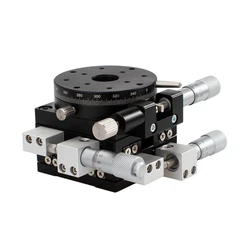
For example, a Manual Xyr Stage provides movement in the X and Y directions as well as rotation. Users need to learn how to identify each axis and its corresponding adjustment knobs or controls. The knobs are usually labeled clearly, but it is important to explain that each turn of the knob corresponds to a specific amount of movement, which is often referred to as the pitch of the screw mechanism.


In addition to the axes, users should also be introduced to the mounting options. Manual multi - axis stages can be mounted on various platforms, such as optical tables or microscope frames. Training should cover how to securely attach the stage to the desired platform using the appropriate screws or clamps. This ensures stability during operation and prevents any unwanted movement that could affect the accuracy of positioning.
Understanding the Movement Mechanisms
Once users are familiar with the hardware, the next step is to understand the movement mechanisms. Manual multi - axis stages typically use screw - driven or gear - driven mechanisms to achieve precise movement.
Screw - driven stages are very common. The screw mechanism converts the rotational motion of the adjustment knob into linear motion. A small rotation of the knob results in a small, precise movement of the stage along the corresponding axis. Training should explain how to calculate the movement based on the pitch of the screw. For instance, if the pitch of the screw is 0.5 mm per revolution, then turning the knob half a revolution will move the stage 0.25 mm.
Gear - driven mechanisms, on the other hand, are used in some stages to provide a more compact and efficient way of transmitting motion. In a gear - driven stage, the rotation of the input gear is transferred to the output gear, which then moves the stage. Users need to learn how to operate the gear - driven stage, including how to adjust the gear ratio if applicable. This knowledge is important for achieving the desired speed and precision of movement.
Basic Positioning Techniques
After understanding the movement mechanisms, users should be trained in basic positioning techniques. This involves learning how to move the stage to a specific position accurately.
The first technique is coarse adjustment. Coarse adjustment is used to quickly move the stage to a general area close to the desired position. Users turn the adjustment knobs relatively quickly to cover a larger distance. However, coarse adjustment is not very precise, and it is usually followed by fine adjustment.
Fine adjustment is used to refine the position and achieve the exact location required. Users turn the adjustment knobs slowly and carefully, often in small increments, to make small corrections to the position. Training should emphasize the importance of using fine adjustment for precise positioning, especially in applications where accuracy is critical.
Another important positioning technique is the use of reference points. Most manual multi - axis stages have reference marks or zero - position indicators. Users should learn how to set the stage to the zero position and use these reference points as a starting point for their positioning operations. This helps to ensure consistency and accuracy in repeated positioning tasks.
Calibration and Accuracy
Calibration is an essential part of using manual multi - axis stages. Training should cover the calibration procedures to ensure that the stage is operating accurately.
The first step in calibration is to check the accuracy of the movement along each axis. This can be done using a calibration gauge or a precision measuring instrument. Users need to learn how to measure the actual movement of the stage and compare it with the expected movement based on the pitch of the screw or gear mechanism. If there is a significant deviation, the stage may need to be adjusted or calibrated.
In addition to axis accuracy, calibration also involves checking the perpendicularity between the axes. In a multi - axis stage, the axes should be perpendicular to each other to ensure accurate positioning in three - dimensional space. Training should include how to use tools such as square gauges to check the perpendicularity and how to make adjustments if necessary.
Safety Precautions
Safety is always a top priority when using manual multi - axis stages. Training should cover the necessary safety precautions to prevent accidents and damage to the equipment.
One of the main safety concerns is over - tightening the adjustment knobs. Over - tightening can damage the screw or gear mechanism, leading to inaccurate movement or even mechanical failure. Training should instruct users to apply only the necessary amount of force when turning the knobs and to avoid excessive tightening.
Another safety issue is the handling of the stage. Manual multi - axis stages are often made of delicate materials and can be easily damaged if mishandled. Users should be trained on how to lift and move the stage carefully, using both hands to support it evenly. They should also be aware of any sharp edges or protruding parts on the stage and take precautions to avoid injury.
Advanced Applications
For more experienced users, training can also cover advanced applications of manual multi - axis stages.
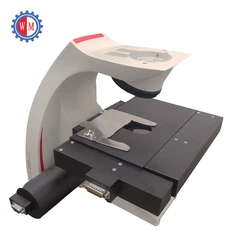
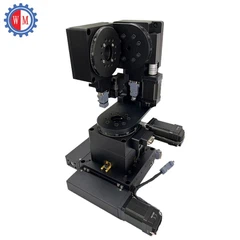
One advanced application is the use of the stage in combination with other equipment. For example, in microscopy, a XYZR Axis Manual Stage can be used in conjunction with a microscope to precisely position the sample for observation. Training should cover how to integrate the stage with the microscope, including how to align the stage with the optical axis of the microscope.
Another advanced application is the use of manual multi - axis stages in alignment tasks. In photonics, for instance, stages are used to align optical components such as lasers and lenses. Training should teach users how to use the stage to align these components accurately, taking into account factors such as the angle of incidence and the focal length of the optical elements.
Troubleshooting
Finally, training should include troubleshooting techniques. Even with proper use and maintenance, manual multi - axis stages may encounter problems from time to time.
Common problems include stuck adjustment knobs, uneven movement, or inaccurate positioning. Training should provide users with a step - by - step guide on how to diagnose and solve these problems. For example, if an adjustment knob is stuck, users should first check if there is any debris or obstruction in the screw or gear mechanism. They can then try to clean the mechanism using a suitable cleaning agent.
If the stage is not moving evenly, it could be due to a misaligned screw or a worn - out gear. Training should cover how to identify the source of the problem and how to make the necessary adjustments or replacements. This knowledge helps users to quickly resolve any issues that may arise during operation and minimize downtime.
Conclusion
In conclusion, the training contents for using manual multi - axis stages cover a wide range of topics, from hardware familiarization to troubleshooting. By providing comprehensive training, users can make the most of these precision instruments and achieve accurate and reliable positioning in their applications.
If you are interested in our Manual Multi - Axis Stages or need further training and support, please feel free to contact us for procurement and洽谈. We are committed to providing high - quality products and excellent customer service.
References
- "Precision Motion Control: Design and Applications" by John A. Paros
- "Optical Instrumentation: Design and Application" by Warren J. Smith


