

In the realm of industrial applications, precision and control are of utmost importance. One crucial component that often comes into play is the manual XY - axis stage. As a supplier of Manual XY - Axis Stages, I am frequently asked whether these stages can be effectively used in industrial settings. In this blog post, I will delve into the capabilities, advantages, and limitations of manual XY - axis stages in industrial applications.
Understanding Manual XY - Axis Stages
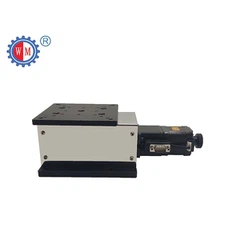
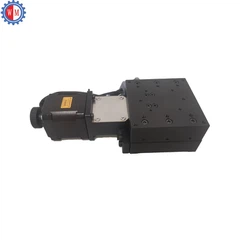
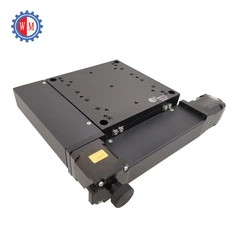
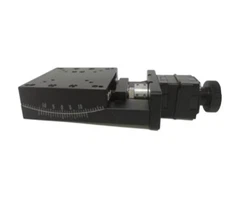
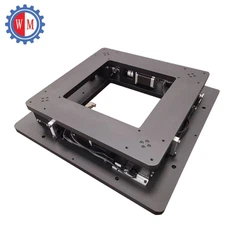
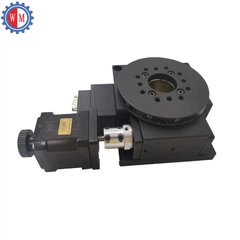
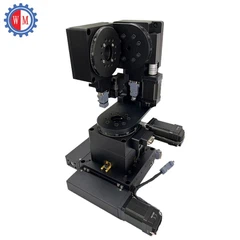
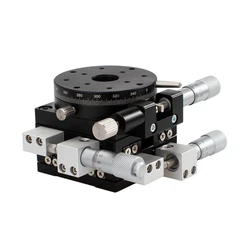
Manual XY - axis stages are mechanical devices that allow for precise movement along two perpendicular axes (X and Y). They typically consist of a base, a platform that moves along the X - axis, and another platform that moves along the Y - axis. The movement is controlled manually, usually through the use of screws or micrometers. These stages offer a high degree of precision, often with resolutions in the micrometer range.
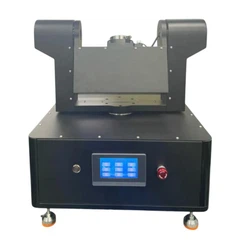
There are several types of manual XY - axis stages available, each designed for specific applications. For instance, the Manual Optical Alignment Stage is specifically engineered for applications where precise alignment of optical components is required. It provides fine - tuned control over the position of lenses, mirrors, and other optical elements.
The Manual Screw - Driven XY Translation Stage is a more general - purpose stage. It uses screws to drive the movement of the platforms along the X and Y axes. This type of stage is known for its simplicity, reliability, and relatively low cost.
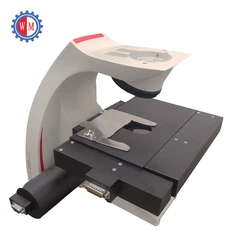
The Manual Laboratory Translation Stage is commonly used in laboratory settings for tasks such as sample positioning and microscopy. It offers smooth and accurate movement, making it suitable for delicate scientific experiments.
Advantages of Manual XY - Axis Stages in Industrial Applications
1. Cost - Effectiveness
One of the primary advantages of manual XY - axis stages is their cost - effectiveness. Compared to their automated counterparts, manual stages are significantly cheaper. This makes them an attractive option for small and medium - sized enterprises that have budget constraints. For industries where high - volume production is not the main focus, or where the application does not require continuous and rapid movement, manual stages can provide a cost - efficient solution.
2. Simplicity and Ease of Use
Manual XY - axis stages are relatively simple in design and operation. They do not require complex programming or sophisticated control systems. Operators can quickly learn how to use these stages, which reduces the training time and associated costs. In addition, the simplicity of manual stages means that they are less prone to technical failures. Maintenance is also straightforward, often requiring only basic mechanical knowledge.


3. High Precision
Despite being manually operated, manual XY - axis stages can offer a high level of precision. With the use of high - quality screws and micrometers, these stages can achieve resolutions in the micrometer or even sub - micrometer range. This level of precision is sufficient for many industrial applications, such as precision machining, microelectronics assembly, and optical component alignment.
4. Customizability
Manual XY - axis stages can be easily customized to meet the specific requirements of different industrial applications. For example, the size of the stage, the travel range, and the load - carrying capacity can all be adjusted according to the needs of the customer. This flexibility allows industries to use manual stages in a wide variety of applications, from small - scale research projects to large - scale manufacturing processes.
Applications of Manual XY - Axis Stages in Industry
1. Microelectronics Manufacturing
In the microelectronics industry, manual XY - axis stages are used for tasks such as die bonding, wire bonding, and printed circuit board (PCB) assembly. These applications require precise positioning of small components, and the high precision of manual stages makes them well - suited for this purpose. For example, when bonding a semiconductor die to a substrate, the stage can be used to accurately position the die, ensuring a reliable electrical connection.
2. Optical Industry
The optical industry relies heavily on manual XY - axis stages for the alignment and assembly of optical components. Whether it is aligning lenses in a camera module or positioning mirrors in a laser system, manual stages can provide the necessary precision. The Manual Optical Alignment Stage is specifically designed for these types of applications, offering fine - tuned control over the position of optical elements.
3. Precision Machining
In precision machining processes, such as milling, turning, and grinding, manual XY - axis stages can be used to position the workpiece accurately. This allows for the production of parts with high dimensional accuracy. For small - batch production or prototyping, manual stages can be a practical option as they can be quickly set up and adjusted for different workpieces.
4. Research and Development
In research and development laboratories, manual XY - axis stages are widely used for various experiments. For example, in materials science research, these stages can be used to position samples for microscopy or spectroscopy analysis. The simplicity and ease of use of manual stages make them ideal for laboratory environments, where researchers can focus on their experiments rather than dealing with complex control systems.
Limitations of Manual XY - Axis Stages in Industrial Applications
1. Limited Speed
One of the main limitations of manual XY - axis stages is their limited speed. Since the movement is controlled manually, it is impossible to achieve the high - speed operation that automated stages can provide. In industries where high - volume production and rapid movement are required, such as mass - manufacturing of consumer electronics, manual stages may not be suitable.
2. Operator Fatigue
Continuous operation of manual XY - axis stages can lead to operator fatigue. Manually turning screws or adjusting micrometers for long periods of time can be physically demanding. This can result in a decrease in productivity and an increase in the likelihood of human error. In applications where long - term and repetitive positioning is required, operator fatigue can become a significant issue.
3. Lack of Automation
Manual XY - axis stages do not offer the same level of automation as their automated counterparts. In modern industrial settings, automation is often preferred as it can improve productivity, reduce labor costs, and ensure consistent quality. For industries that are moving towards Industry 4.0 and smart manufacturing, the lack of automation in manual stages may be a drawback.
Conclusion
In conclusion, manual XY - axis stages can indeed be used in industrial applications. Their cost - effectiveness, simplicity, high precision, and customizability make them suitable for a wide range of industries, including microelectronics, optics, and precision machining. However, they also have limitations, such as limited speed, operator fatigue, and lack of automation.
When considering whether to use manual XY - axis stages in an industrial application, it is important to carefully evaluate the specific requirements of the application. For applications where cost, simplicity, and precision are the main concerns, manual stages can be an excellent choice. If high - speed production and automation are crucial, then automated stages may be more appropriate.
As a supplier of Manual XY - Axis Stages, we are committed to providing high - quality products and excellent customer service. If you are interested in learning more about our manual XY - axis stages or have specific requirements for your industrial application, please feel free to contact us for a detailed discussion and procurement negotiation.
References
- "Precision Motion Control: Fundamentals, Devices, and Applications" by Peter R. Schofield.
- "Industrial Automation: Principles and Applications" by Benjamin W. Ku.
- "Optical Engineering: Design, Fabrication, and Testing" by Joseph M. Geary.


