
Basic industry cognition
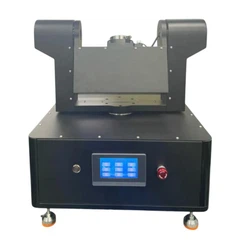
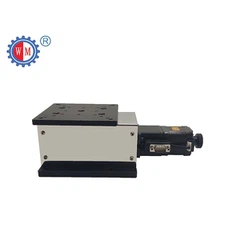
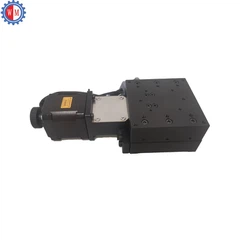
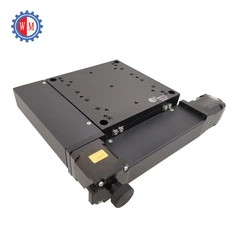
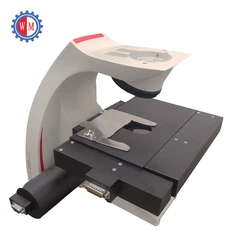
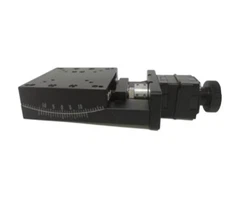
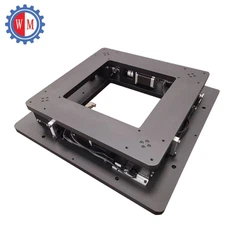
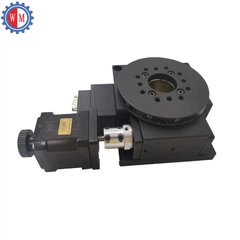
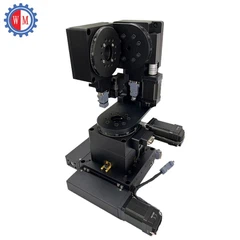
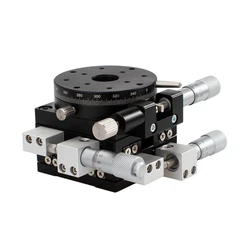
- Definition and Structure: The xyz positioning stage is a mechatronic device designed with three-degree-of-freedom linear motion. It consists of three independent linear drives, typically including components such as guide rails, ball screws, servo motors or stepper motors, and is capable of achieving precise motion control in the X, Y, and Z directions.
- Working principle: xyz positioning stage by driving the ball screw or synchronous belt and other transmission mechanisms through the motor, the rotational motion of the motor is converted into the linear motion of the slider on the guide rail, thereby achieving precise displacement control in three directions. Users can send instructions through programming or the control system to precisely control the movement distance, speed, and position of the slide table in all directions.
The characteristics of xyz positioning stage
- High-precision positioning: The xyz positioning stage employs precise ball screws, linear guides, and other components, combined with high-precision motors and control systems, achieving positioning accuracy at the micrometer level.
- High speed and high efficiency: It can respond quickly to control signals, achieve high-speed linear motion, and improve production efficiency.
- Modular design: The modular structure is convenient for installation, maintenance, and expansion. It can be flexibly configured according to actual needs and also supports customized design to meet the requirements of different industries and application scenarios.
- Strong load capacity: According to different application requirements, appropriate transmission methods and structural designs can be selected to meet the handling and positioning needs of different loads.
The application fields of xyz positioning stage
- Industrial automation: It is used for arm motion control of robots, tool positioning of CNC machine tools, material handling, and assembly on automated production lines, etc.
- Electronic manufacturing: such as wafer handling in semiconductor equipment, positioning and soldering of PCB processing equipment, and precise assembly of electronic components, etc.
- Medical equipment: precise operation of surgical robots, sample positioning and scanning of medical testing instruments, imaging of medical imaging equipment, etc.
- Research fields: Sample processing and analysis of laboratory automation equipment, positioning and movement of precision measurement equipment, etc.
The selection logic of xyz positioning stage
- Clarify the usage environment: It is necessary to determine whether the xyz positioning stage is used in a general environment or a special environment, such as a dust-free environment, a dusty environment, an oily environment, or a corrosive environment, etc. A dust-free environment may require a fully sealed electric slide to prevent dust from entering. In harsh environments such as dusty and oily ones, slides with high protection grades should be selected.
- Determine the load capacity: It is necessary to clearly define the maximum load that the xyz positioning stage needs to withstand, including static load and dynamic load. Not only the weight of the load but also the position of its center of gravity should be taken into account, as a shift in the center of gravity will generate additional torque, affecting the operational accuracy and stability of the slide table.
- Plan the travel length: According to the actual working requirements, determine the motion travel required for the X, Y, and Z axes, that is, the effective path length that the slider can slide on thXYZyz positioning stage. Long strokes may be more suitable for belt-type modules, while short strokes may be more suitable for lead screw type modules.
- Consider the precision requirements: According to the positioning accuracy requirements of the specific application, select the appropriate precision grade of the slide table. Attention should be paid to parameters such as positioning accuracy, repeatability, parallelism of movement, backlash, and straightness of movement. Ball screw transmission usually has higher positioning accuracy.
- Determine the speed requirements: Based on the production efficiency demands of the application scenario, determine the maximum speed and acceleration required for the XYZ positioning stage. The speed of the XYZ positioning stage is affected by the motor speed, load, and transmission mode. For example, synchronous toothed belt transmission may have an advantage in terms of speed.
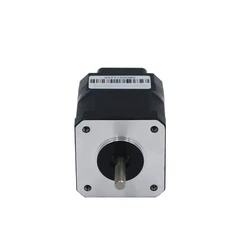
- Select the drive mode: Common drive modes include servo motor drive, stepper motor drive, and linear motor drive etc. The servo motor drive features high precision and fast response, making it suitable for scenarios with high dynamic performance requirements. A stepper motor drive has a relatively low cost and is suitable for simple applications with low speed and light load. A linear motor drive has no mechanical transmission components and is extremely fast, but it is relatively expensive.
- Consider the installation method: It is necessary to select an appropriate installation method based on the actual structure and spatial layout of the equipment, such as horizontal installation, vertical installation, wall installation, or inclined installation etc. Different installation methods have different requirements for the force distribution and rigidity of the slide table. For example, when installed vertically, an additional balance cylinder or braking motor needs to be configured to prevent slippage in case of power failure.


