
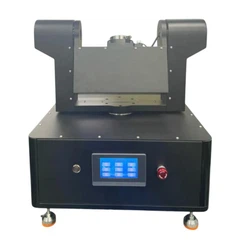
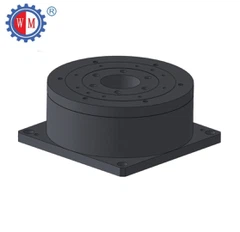
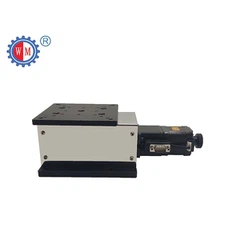
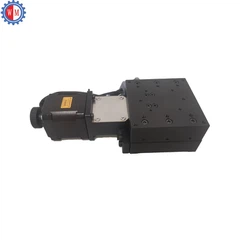
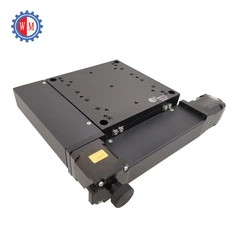
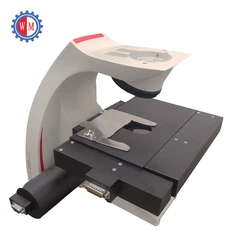
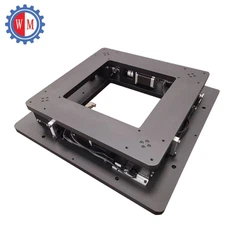


Hey there! As a supplier of Visual Alignment Stages, I often get asked about the evaluation metrics for these nifty devices. So, I thought I'd take a moment to break it down for you.
First off, let's talk about what a Visual Alignment Stage is. In simple terms, it's a device that helps in precisely aligning objects in a visual system. Whether you're in the semiconductor industry, microscopy, or any field that requires high - precision alignment, a Visual Alignment Stage is a must - have tool.
Accuracy
One of the most crucial evaluation metrics for a Visual Alignment Stage is accuracy. Accuracy refers to how close the actual position of the stage is to the desired position. In high - precision applications, even the slightest deviation can lead to significant errors. For example, in semiconductor manufacturing, where tiny components need to be aligned with extreme precision, an inaccurate alignment stage can result in defective products.
When evaluating the accuracy of a Visual Alignment Stage, we look at two main aspects: linear accuracy and angular accuracy. Linear accuracy measures how accurately the stage can move in a straight line. It's usually expressed in micrometers (μm). A high - quality stage will have a very low linear accuracy error, meaning it can move to the exact position you want it to with minimal deviation.
Angular accuracy, on the other hand, is about how accurately the stage can rotate. This is important when you need to align objects at specific angles. It's typically measured in arc - seconds. The lower the angular accuracy error, the more precise the rotational movement of the stage.
Repeatability
Repeatability is another key metric. It's all about how consistently the stage can return to the same position over multiple movements. Even if a stage has high accuracy, if it can't repeat the same movement precisely every time, it's not going to be very useful.


Let's say you're using a Motorized UVW Alignment Stage to align a series of components. You need the stage to move to the same position for each component. If the repeatability is poor, the alignment will vary from one component to the next, leading to inconsistent results.
Repeatability is usually expressed as a range. For example, a stage might have a repeatability of ± 1 μm. This means that every time the stage moves to a particular position, it will be within 1 μm of that position. A high - repeatability stage is essential for applications where consistency is critical.
Resolution
Resolution is the smallest increment of movement that the stage can make. It determines how finely you can control the position of the stage. A stage with high resolution can make very small, precise movements, which is crucial for applications that require detailed alignment.
For instance, in microscopy, you might need to move the sample in very small steps to get a clear view of different parts of the specimen. A stage with low resolution won't be able to make these small, precise movements, and you'll end up with a less detailed image.
Resolution is typically measured in nanometers (nm) or micrometers (μm). The smaller the resolution value, the higher the precision of the stage.
Speed
Speed is an important consideration, especially in applications where time is of the essence. The speed of a Visual Alignment Stage refers to how quickly it can move from one position to another.
In a production environment, a faster stage can increase the throughput of the manufacturing process. However, there's a trade - off between speed and accuracy. If you try to move the stage too quickly, it might not be able to stop precisely at the desired position, leading to a decrease in accuracy.
So, it's important to find a balance between speed and accuracy based on your specific application. Some stages allow you to adjust the speed, so you can optimize it for your needs.
Load Capacity
Load capacity is the maximum weight that the stage can support without affecting its performance. If you try to place a load on the stage that's too heavy, it can cause the stage to move less accurately or even damage the device.
When choosing a Visual Alignment Stage, you need to consider the weight of the objects you'll be aligning. For example, if you're aligning large, heavy components, you'll need a stage with a high load capacity. On the other hand, if you're working with small, lightweight objects, a stage with a lower load capacity might be sufficient.
Stability
Stability is about how well the stage can maintain its position over time. A stable stage won't drift or vibrate, which is crucial for accurate alignment.
In some applications, such as long - exposure microscopy or high - precision metrology, any movement or vibration of the stage can ruin the results. Factors that can affect the stability of a stage include the quality of the mechanical components, the design of the stage, and the environment in which it's used.
Ease of Use
Last but not least, ease of use is an important evaluation metric. A stage that's difficult to operate will slow down your workflow and increase the chances of errors.
A user - friendly stage should have an intuitive control interface, clear instructions, and easy - to - understand software (if applicable). It should also be easy to install and set up. Some stages come with pre - calibrated settings, which can save you a lot of time and effort.
If you're in the market for a Visual Alignment Stage, you might also want to consider the XYY Alignment Stage. It offers unique features and capabilities that can be tailored to your specific needs.
In conclusion, when evaluating a Visual Alignment Stage, you need to consider a combination of these metrics. Each metric plays a crucial role in determining the performance of the stage, and the importance of each metric will depend on your specific application.
If you're interested in learning more about our Visual Alignment Stages or have any questions about which stage is right for your application, feel free to reach out. We're here to help you make the best choice for your needs. Whether you're a small research lab or a large manufacturing facility, we've got the perfect stage for you. Let's start a conversation and see how we can improve your alignment processes!
References
- Smith, J. (2020). Precision Alignment Techniques in Modern Manufacturing. Journal of Manufacturing Science.
- Johnson, A. (2019). Evaluation of Motion Control Systems for Visual Alignment. Motion Control Magazine.


