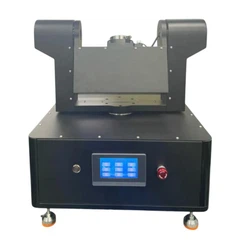
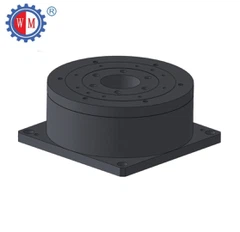
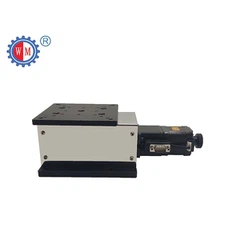
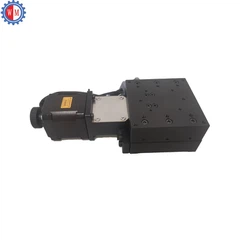
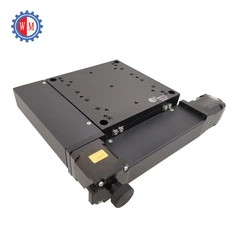
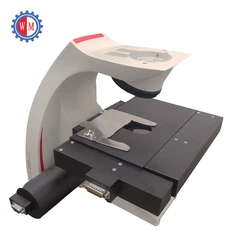
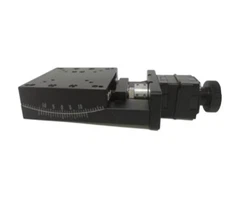
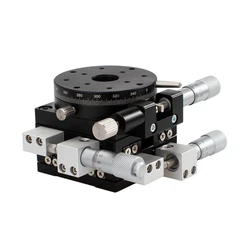
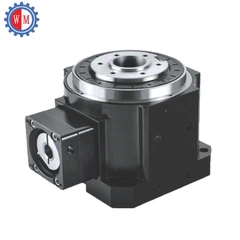
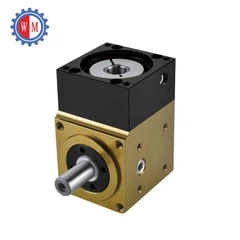


Hey there! As a supplier of Manual Rotary Stages, I often get asked a bunch of questions from customers. One question that pops up quite a bit is, "Do manual rotary stages have a limit switch?" Let's dig into this topic and see what's what.
First off, let's understand what a manual rotary stage is. A Manual Rotating Stage is a mechanical device that allows for rotational movement. It's commonly used in various industries like microscopy, photonics, and semiconductor manufacturing. Unlike motorized stages, manual rotary stages are operated by hand, usually through a knob or a lever.
Now, back to the main question: do they have a limit switch? Well, the short answer is, it depends. Not all manual rotary stages come equipped with limit switches. Limit switches are typically associated with motorized systems where they serve as safety mechanisms to prevent the stage from moving beyond a certain point. They can stop the motor when the stage reaches a predefined position, protecting both the equipment and the samples being worked on.
In the case of manual rotary stages, the need for limit switches isn't as obvious. Since they're operated manually, the user has direct control over the movement. You can simply stop turning the knob when you reach the desired position. However, there are situations where having a limit switch on a manual rotary stage can be beneficial.
Let's say you're working on a project where you need to repeatedly rotate the stage to the same position. It can be time - consuming and prone to human error to manually align the stage every single time. A limit switch can be set at the desired position, and when the stage reaches that point, it provides a clear indication that you've hit the mark. This can improve the accuracy and efficiency of your work.
Another scenario is when you're dealing with delicate samples or expensive equipment. Accidentally over - rotating the stage could cause damage. A limit switch can act as a safeguard, preventing any excessive movement that might lead to costly mistakes.
So, if you're in the market for a manual rotary stage and you think a limit switch could be useful for your application, you're in luck. Some manufacturers, including us as a supplier, offer manual rotary stages with optional limit switches. These switches can be customized to fit your specific requirements. You can set the limits based on the angle of rotation you need, ensuring that the stage stops precisely where you want it to.


When it comes to the types of limit switches available for manual rotary stages, there are a few options. One common type is the mechanical limit switch. These switches work based on physical contact. When the stage reaches a certain position, it physically presses against the switch, which then sends a signal to indicate that the limit has been reached. Mechanical limit switches are relatively simple and reliable, but they do require some physical space for installation.
Another type is the optical limit switch. These use light sensors to detect the position of the stage. They're more precise than mechanical switches and can offer a higher level of accuracy. However, they're also more expensive and may require more complex setup.
Now, let's talk about how to choose whether you need a limit switch for your manual rotary stage. The first thing you need to consider is the nature of your work. If you're doing quick, one - off rotations where precision isn't critical, a limit switch might not be necessary. You can rely on your own judgment to stop the rotation at the right time.
On the other hand, if you're involved in high - precision work, such as aligning optical components or conducting repetitive experiments, a limit switch can be a game - changer. It can save you time and reduce the margin of error, leading to better results.
Cost is also a factor. Adding a limit switch to a manual rotary stage will increase the price. You need to weigh the benefits of having a limit switch against the additional cost. If the increased accuracy and efficiency it provides will lead to significant savings in the long run, then it might be worth the investment.
As a supplier, we're here to help you make the right decision. We have a wide range of Manual Rotating Stages available, some with limit switches and some without. Our team of experts can answer all your questions and guide you through the selection process. Whether you're a small research lab or a large manufacturing facility, we can find a solution that fits your needs and budget.
If you're interested in learning more about our manual rotary stages or want to discuss whether a limit switch is right for you, don't hesitate to reach out. We're always happy to have a chat and help you find the perfect stage for your application. Contact us today to start the conversation and take your work to the next level.
References
- Industry standard manuals on rotary stages
- Technical papers on precision motion control


