


As a supplier of Motorized Lab Jacks, I am often asked about the acceleration and deceleration capabilities of these essential pieces of laboratory equipment. Understanding these capabilities is crucial for users who rely on precise and efficient vertical movement in their scientific experiments and research. In this blog post, I will delve into the concept of acceleration and deceleration in motorized lab jacks, their importance, and how they impact the performance of these devices.
What is Acceleration and Deceleration in a Motorized Lab Jack?
Acceleration refers to the rate at which the speed of the motorized lab jack increases. In other words, it is how quickly the jack can go from a standstill to its maximum speed. Deceleration, on the other hand, is the rate at which the speed of the jack decreases. It determines how fast the jack can come to a stop from its maximum speed. These two parameters are measured in units of distance per time squared, such as millimeters per second squared (mm/s²).
Importance of Acceleration and Deceleration Capabilities
The acceleration and deceleration capabilities of a motorized lab jack are important for several reasons. Firstly, they affect the overall efficiency of the laboratory operations. A jack with high acceleration can reach the desired position more quickly, reducing the time spent on each experiment. This is particularly important in high - throughput laboratories where time is of the essence.
Secondly, proper deceleration is crucial for ensuring the safety of the samples and the equipment. If the jack decelerates too slowly, it may overshoot the target position, potentially causing damage to the samples or the instruments mounted on the jack. On the other hand, if the deceleration is too rapid, it can generate excessive forces that may also harm the samples or cause mechanical stress on the jack itself.
Factors Affecting Acceleration and Deceleration
Several factors influence the acceleration and deceleration capabilities of a motorized lab jack. One of the most significant factors is the motor power. A more powerful motor can provide greater torque, which allows for faster acceleration and deceleration. Additionally, the type of motor used, such as a stepper motor or a servo motor, can also impact these capabilities. Stepper motors are known for their precise control but may have limitations in terms of high - speed acceleration. Servo motors, on the other hand, can offer better performance in terms of both speed and acceleration.
The load capacity of the jack is another important factor. A heavier load will require more force to accelerate and decelerate. Therefore, a motorized lab jack with a higher load capacity may have a lower acceleration and deceleration rate compared to a lighter - duty jack. The mechanical design of the jack, including the gearing system and the type of linear motion guide, also plays a role. A well - designed gearing system can transfer the motor's power more efficiently, resulting in better acceleration and deceleration performance.
Measuring Acceleration and Deceleration
To measure the acceleration and deceleration of a motorized lab jack, specialized equipment can be used. One common method is to use a motion sensor, such as an encoder or a laser displacement sensor. These sensors can accurately measure the position and velocity of the jack over time. By analyzing the change in velocity, the acceleration and deceleration rates can be calculated.
Another approach is to use the built - in control system of the motorized lab jack. Many modern jacks are equipped with sophisticated control algorithms that can monitor and adjust the acceleration and deceleration parameters. These systems can provide real - time feedback on the performance of the jack and allow for fine - tuning of the acceleration and deceleration settings.
Applications and Their Requirements
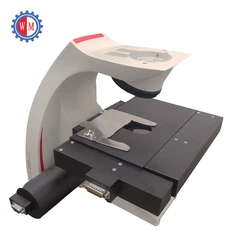
Different applications have different requirements for the acceleration and deceleration capabilities of motorized lab jacks. For example, in microscopy applications, where precise positioning of the sample is required, a low - acceleration and smooth - deceleration profile is often preferred. This ensures that the sample is not disturbed during the movement, resulting in clear and accurate images.
In contrast, in industrial automation applications, such as pick - and - place operations in a manufacturing line, high acceleration and deceleration rates are desirable. These applications require the jack to move quickly between different positions to maximize the throughput.


Our Product Range and Their Capabilities
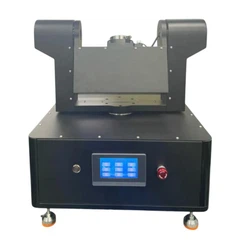
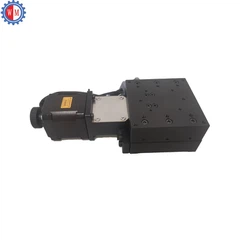
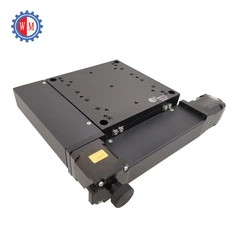
As a supplier, we offer a wide range of motorized lab jacks to meet the diverse needs of our customers. Our Motorized Lift Stage is designed for general laboratory use. It features a high - torque motor that provides excellent acceleration and deceleration performance, making it suitable for a variety of applications.
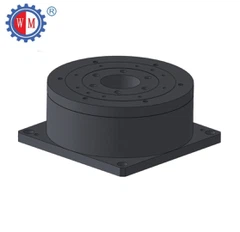
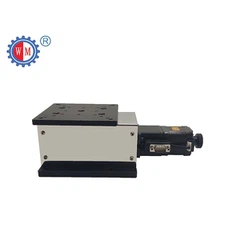
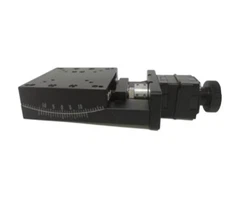
The Motor Z Translation Stage is another popular product in our portfolio. It is specifically designed for precise vertical movement in applications such as microscopy and optical alignment. This stage offers a smooth and controlled acceleration and deceleration profile to ensure accurate positioning.
For heavy - duty applications, our Heavy Load Lab Scissor Jack is the ideal choice. Despite its high load capacity, it is engineered to provide a reasonable acceleration and deceleration rate, thanks to its powerful motor and robust mechanical design.
Conclusion
The acceleration and deceleration capabilities of a motorized lab jack are critical factors that affect its performance, efficiency, and safety. By understanding these capabilities and the factors that influence them, laboratory users can make informed decisions when selecting a motorized lab jack for their specific applications.
If you are in the market for a motorized lab jack and need more information about our products' acceleration and deceleration capabilities, or if you have any other questions, please feel free to contact us. We are committed to providing you with the best - suited solutions for your laboratory needs. Our team of experts is ready to assist you in choosing the right product and ensuring its optimal performance in your applications.
References
- "Motion Control Handbook", Published by an industry - leading publisher on motion control technology.
- Technical specifications of our motorized lab jack products.


