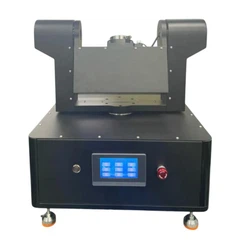
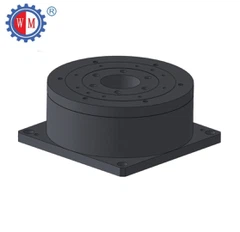
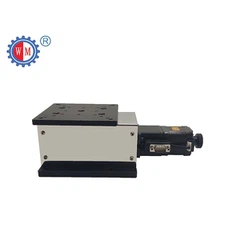
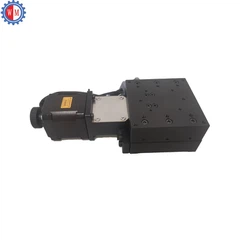
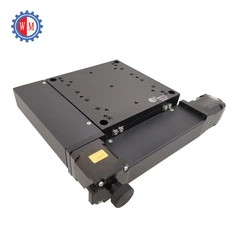
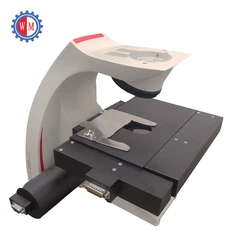
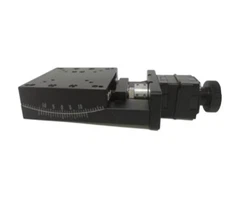
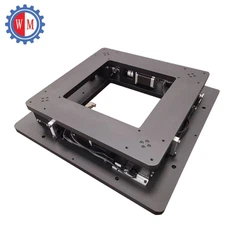
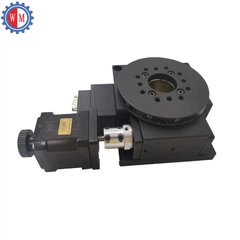
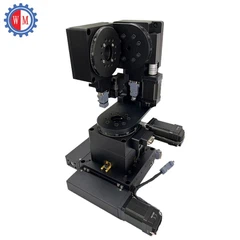
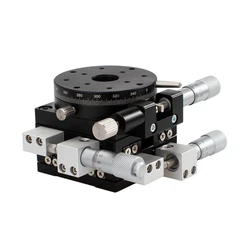
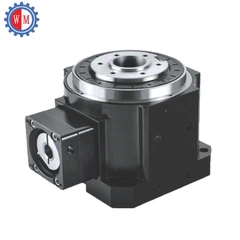
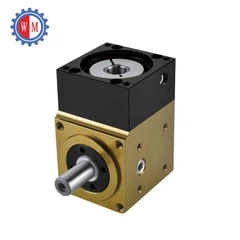


A motorized rotary stage is a precision motion control device designed to rotate a platform, sample, optic, or workpiece around a single fixed axis with high accuracy, repeatability, and programmable control. Unlike a simple turntable or manual rotary stage that relies on hand adjustment, a motorized rotary stage uses an electric motor-typically a stepper, servo, or direct-drive torque motor-combined with bearings, a drive mechanism, and often an encoder to deliver automated angular positioning.
In laboratory, industrial, and OEM settings, the motorized rotary stage enables reliable, hands-free rotation that eliminates operator variability and supports integration into larger automated systems. Whether aligning optics, inspecting wafers, or positioning samples under a microscope, the motorized rotary stage provides the controlled rotational degree of freedom that linear stages alone cannot deliver.

How a Motorized Rotary Stage Works
At its core, a motorized rotary stage consists of a rotating platform (the table or top plate) supported by a bearing system that constrains motion to pure rotation about a central axis. A motor supplies torque, which is transmitted through a drive mechanism to the platform. Feedback devices such as optical encoders or Hall-effect sensors report angular position to a motion controller, enabling closed-loop or open-loop operation.
Common drive architectures include:
Worm-gear drives: A precision worm meshes with a worm gear attached to the rotating table. This design delivers high torque, self-locking capability (useful for holding offset loads), and good positional stiffness at moderate speeds. Many commercial motorized rotary stage models use preloaded anti-backlash worm gears for improved bidirectional repeatability.
Direct-drive systems: A torque motor is coupled directly to the rotating table with no intervening gears. These stages offer zero backlash, higher maximum speeds, smoother velocity, and excellent dynamic performance, making them ideal for continuous scanning or high-throughput applications.
Belt or other transmissions: Less common for ultra-precision work but useful when a balance of cost, speed, and through-hole size is required.
Bearing choices further define performance. Crossed-roller bearings provide high stiffness and load capacity with low friction. Ball bearings are cost-effective for lighter loads. Air bearings eliminate mechanical contact entirely, delivering exceptional runout, wobble, and lifetime performance for metrology and semiconductor applications.
Many motorized rotary stage designs incorporate a central aperture (hollow core). This through-hole allows cables, beams, vacuum lines, or optical paths to pass through the axis of rotation-critical for microscope stages, laser systems, and rotary joints.
Key Performance Specifications of a Motorized Rotary Stage
When evaluating a motorized rotary stage, engineers typically examine:
Resolution and minimum incremental motion: How finely the stage can be commanded, often from a few arcseconds down to micro-radians with microstepping or high-resolution encoders.
Accuracy and repeatability: Absolute accuracy (how close the stage reaches a commanded angle) and bidirectional or unidirectional repeatability. High-end stages achieve repeatability of a few arcseconds or better.
Load capacity: Axial, radial, and moment load ratings. Industrial motorized rotary stage models handle tens to hundreds of kilograms, while laboratory versions support lighter optics or samples.
Speed and acceleration: Worm-gear stages typically operate at lower RPM with high torque; direct-drive stages can reach hundreds of RPM.
Wobble, runout, and flatness: Geometric errors that affect the quality of rotation, especially important in optical and metrology uses.
Vacuum or cleanroom compatibility: Many manufacturers offer versions suitable for vacuum environments or low-outgassing materials.
These specifications determine whether a given motorized rotary stage suits semiconductor inspection, biomedical imaging, or industrial automation.
Motorized Rotary Stage vs. Manual Rotary Stage
A manual rotary stage uses a hand knob, often with a worm drive and graduated scale, for precise but operator-dependent positioning. It is simple, inexpensive, and adequate for occasional alignment tasks. In contrast, a motorized rotary stage adds a motor, controller interface, and usually feedback. The advantages are clear:
- Programmable motion profiles and sequences
- Higher repeatability across many cycles
- Ability to operate under heavy loads or in inaccessible locations
- Integration with multi-axis systems and software
- Elimination of human error and fatigue
- When applications require frequent repositioning, synchronized multi-axis motion, or data logging of angular position, the motorized rotary stage becomes the preferred solution
Common Applications of Motorized Rotary Stages
The versatility of the motorized rotary stage spans research and industry:
Optics and photonics
Polarizers, waveplates, filters, and laser components are routinely rotated with high angular precision. A motorized rotary stage maintains alignment stability while allowing automated optimization of polarization or beam path.
Microscopy and life sciences
Sample rotation under a microscope enables multi-angle imaging, fluorescence techniques, and live-cell observation. Stages with large apertures and low profiles integrate easily into inverted or upright microscope setups.
Semiconductor and metrology
Wafer inspection, scribing, sensor testing, and precision measurement rely on accurate angular positioning. Direct-drive and air-bearing motorized rotary stage models deliver the speed and geometric fidelity required for high-throughput production.
Automation, robotics, and manufacturing
Indexing tables, fourth-axis CNC motion, assembly fixtures, and testing stations use robust motorized rotary stage designs capable of continuous rotation and substantial payload.
Other fields
Aerospace component testing, medical device manufacturing, and scientific instrumentation all benefit from the controlled rotation a motorized rotary stage provides.
Choosing the Right Motorized Rotary Stage
- Selecting an appropriate motorized rotary stage begins with application requirements:
- Orientation (vertical, horizontal, or inverted) and resulting load vectors.
- Required accuracy, speed, and continuous versus intermittent motion.
- Payload size, weight, and whether the center of mass is offset.
- Need for a through aperture and its diameter.
- Environmental constraints (vacuum, cleanroom, temperature range).
- Control interface preferences (stepper vs. servo, integrated controller, encoder type).
- Worm-gear motorized rotary stage models excel when high holding torque and moderate speeds are needed. Direct-drive stages shine in high-speed, low-backlash, or continuous-scan scenarios. Consulting manufacturer selection guides and application engineers helps match the stage to the specific mechanical and performance envelope.
Benefits and Future Trends
The primary benefits of a motorized rotary stage are precision, automation, and reliability. Once configured, the stage executes complex angular sequences with consistency that manual methods cannot match. Modern designs increasingly incorporate integrated controllers, absolute encoders, and network interfaces for easier system integration.
Looking ahead, advances in direct-drive motors, air-bearing technology, and compact high-resolution encoders continue to push performance boundaries. Vacuum-compatible and ultra-low-profile motorized rotary stage variants expand use into emerging fields such as quantum optics and advanced semiconductor packaging.
In summary, a motorized rotary stage is a specialized positioning platform that delivers accurate, automated rotation about a single axis. By combining a motor, precision bearings, drive mechanism, and feedback, it solves angular motion challenges across optics, microscopy, semiconductor manufacturing, metrology, and industrial automation. Understanding the working principles, performance metrics, and application requirements allows engineers and researchers to select and deploy the right motorized rotary stage for their needs, achieving the repeatability and control that modern precision systems demand.


