
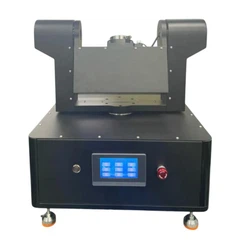
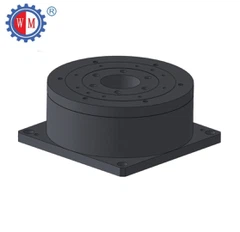
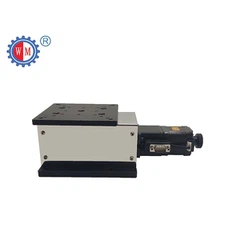
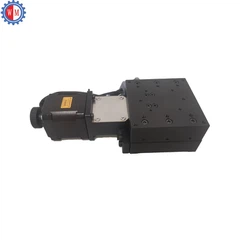
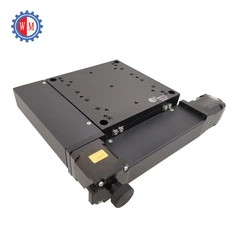
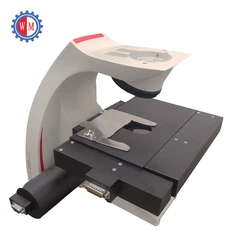
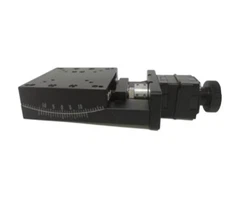
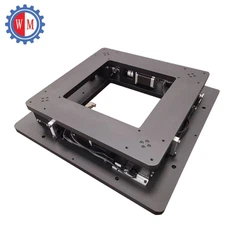
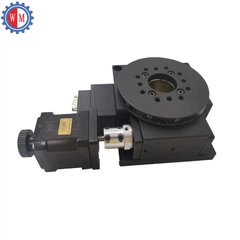
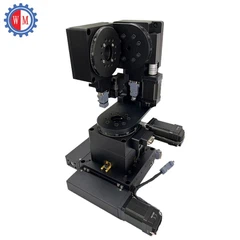
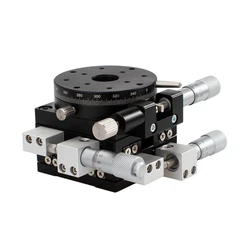
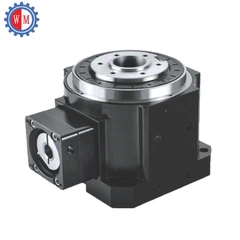

Motorized goniometer stages serve as crucial auxiliary tools across numerous fields, proving useful in industrial production, scientific research experiments, and even daily office work. However, when it comes to purchasing a goniometer stage, people often hesitate between motorized and manual models. We will analyze the core differences between these two types in detail to help you make a more suitable choice.
Goniometer stage Adjustment Method: motorized vs manual operation
I. Manual goniometer stage
- Manual goniometers primarily rely on mechanical structures such as handwheels, handles, or lead screws to adjust the angle. For instance, the common manual fgoniometer stage in a laboratory requires operators to rotate the handwheel, using worm gear transmission or lead screw-nut transmission, to gradually change the tilt angle of the stage. This adjustment method demands a certain level of operational skill from the user, who must constantly monitor the angle change during the adjustment process to achieve the desired angle. For example, in optical experiments, to make light irradiate at a specific angle, researchers need to repeatedly fine-tune a manually curved table, which is quite time-consuming and labor-intensive.


2. Motorized goniometer stage
- Motorized goniometer stage utilizes motor drive-simply pressing a control button allows for easy angle adjustment. Some high-end Motorized goniometer stages are also equipped with a digital control panel, enabling users to accurately input the target angle value, and the device will automatically adjust to the corresponding position. In automated production lines, the product inspection process requires frequent angle adjustments of testing equipment; a Motorized goniometer stage can quickly respond to instructions, efficiently complete angle switching, and significantly improve inspection efficiency.
II. Goniometer stage Parameters
1. The adjustment precision of the manual goniometer stage largely depends on the precision of its mechanical structure and the operator's proficiency. The minimum adjustment increment of the ordinary manual goniometer stage is generally a few minutes of arc (as an angular unit, 1 degree = 60 minutes of arc).
- Motorized goniometer stages have a distinct advantage in terms of precision. Equipped with advanced motor control technology and precision sensors, their adjustment precision can reach the arcsecond level (as an angular unit, 1 degree = 3600 arcseconds). The tiltable angle ranges from ±8° to ±10°, and they adopt a crossed guideway structure. Made mainly of aluminum alloy, they can achieve an adjustment speed of 20° per second. We also provide matching controllers for customers.
III. Customized solution
Our goniometer stage can be combined with a translation stage and a rotary stage for application in various industries. Now, we would like to share with you some of our successful cases.
The goniometer stage for the customization process
1. Demand communication and demand confirmation Firstly, we have in-depth communication with the customer to clarify the core customization requirements, including the expected application scenarios of the goniometer stage (such as industrial testing, scientific research, etc.), load-bearing capacity, adjustable Angle range, precision requirements, size specifications, and special functional requirements (such as matching controllers or integrating sensors). Then, we sort out and confirm the requirements with the client, forming a clear requirements document.
2. Quotation and contract signing
After evaluating the parameter requirements and confirming that we can meet the customer's requirements. We calculate the cost based on factors such as materials, processing difficulty, and technical requirements, and provide detailed quotations to customers. After the customer confirms the quotation, both parties sign a formal customization contract, clearly stipulating the delivery date, quality standards, payment terms, after-sales service, and other details to ensure the smooth progress of the customization project.
3. Preliminary design of the plan
After the contract was signed, based on the confirmed requirements, our technical team designed an initial customized plan. This includes choosing appropriate materials (such as aluminum alloy, stainless steel), determining the mechanical structure (such as the cross guide rail of the electric model, the handwheel drive structure of the manual model), and formulating technical parameters (such as adjusting speed, precision level). We also provide 2D/3D design drawings to visually present the structure of the goniometer stage.
4. Plan review and adjustment
We submitted the initial plan and design drawings to the client for review. We listen to the client's opinions on the plan, such as adjustments to the structure, parameters, and materials, and make corresponding optimizations and modifications to the plan. Repeat this process until the customer confirms that the solution fully meets their expectations.
5. Production and processing
Our production team starts production strictly in accordance with the confirmed plan and design drawings. The key links include material cutting, precision processing (to ensure structural accuracy), component assembly (such as installing motors, guiderails sr handwheels, ls), and initial commissioning (testing basic functions such as Angle adjustment and load-bearing). We conduct real-time quality checks during the production process to avoid deviations from requirements.
6. Testing and Acceptance
After production is completed, we conduct a comprehensive test on the custom goniometer stage, including parameters such as adjustment accuracy, load-bearing capacity, operational stability, and functional completeness. Then invite the customer to conduct on-site acceptance or provide test reports and videos for remote confirmation. If the customer requests minor adjustments, we will promptly optimize them until the product is accepted as qualified.
7. Delivery and after-sales support
We arrange for safe packaging and deliver the qualified goniometer stage to the location designated by the customer. After delivery, we will provide installation guidance (if necessary) and operation training to help customers use the product correctly. We also offer a stipulated after-sales warranty period and respond promptly to customers' maintenance or technical consultation needs within the warranty period.


