
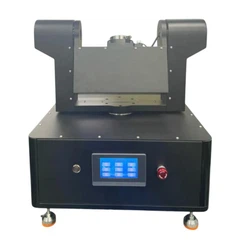
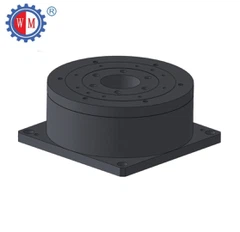
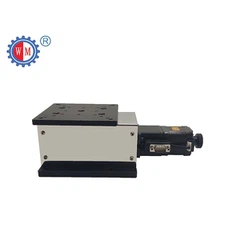

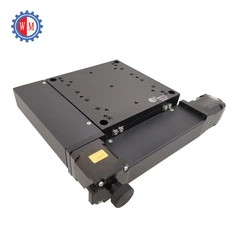
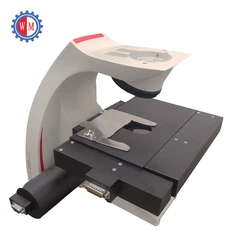
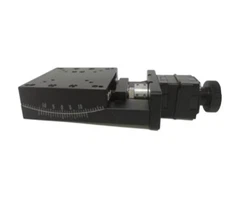
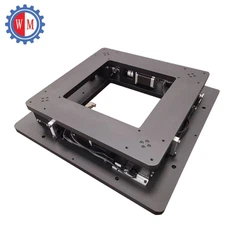
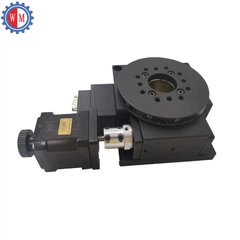


In the ever - evolving world of laboratory research and experimental setups, the choice of equipment plays a crucial role in the accuracy and success of the work. One such piece of equipment that often comes into consideration is the manual goniometer table. As a manual goniometer table supplier, I am frequently asked whether these devices can be effectively used in a laboratory environment. In this blog post, we will delve into the capabilities, limitations, and suitability of manual goniometer tables for laboratory use.
Understanding Manual Goniometer Tables
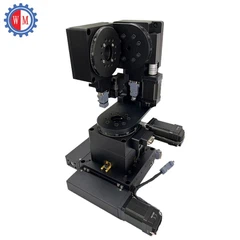
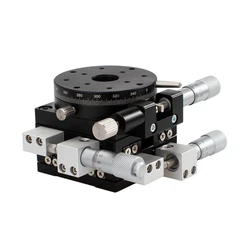
A manual goniometer table is a precise mechanical device used for angular measurement and adjustment. It typically allows the user to rotate an object or a sample along one or more axes with a high degree of accuracy. The rotation can be controlled manually, usually through a set of knobs or levers that are calibrated to provide specific angular increments. There are different types of manual goniometer tables available, such as the Manual Goniometer Stage and the Pitch Yaw Roll Manual Tilt Stage. These devices vary in terms of the number of axes they support, their load capacity, and their angular resolution.
Advantages of Manual Goniometer Tables in a Laboratory
1. Cost - effectiveness
Cost is always a significant factor in laboratory budgeting. Manual goniometer tables are generally more affordable than their automated counterparts. For laboratories with limited funds, a manual goniometer table can provide a cost - effective solution for conducting angular measurements and adjustments. This allows researchers to allocate their resources to other essential aspects of their experiments, such as sample preparation or data analysis.
2. Simplicity and Ease of Use
Manual goniometer tables are relatively simple in design and operation. They do not require complex programming or software to function. Researchers can quickly learn how to use them, which is particularly beneficial in a fast - paced laboratory environment where time is of the essence. The straightforward nature of manual operation also means that there is less chance of technical glitches or software malfunctions, reducing the downtime associated with equipment maintenance and repair.
3. High Precision in Controlled Environments
In a laboratory setting, where experiments often require a high degree of precision, manual goniometer tables can deliver excellent results. The calibrated knobs and levers allow for precise angular adjustments, and the mechanical design of these tables ensures that the set angles remain stable over time. This stability is crucial for experiments that involve long - term observations or measurements, as any unwanted movement or drift can significantly affect the accuracy of the results.
4. Compatibility with Various Samples
Manual goniometer tables can be used with a wide range of samples, including small objects, delicate specimens, and larger components. They can accommodate different types of fixtures and mounting options, making them versatile for various experimental applications. Whether it is a biological sample under a microscope or a mechanical part being tested for alignment, a manual goniometer table can provide the necessary angular adjustment.
Applications of Manual Goniometer Tables in Laboratories
1. Optical Experiments
In optical laboratories, manual goniometer tables are used for a variety of purposes. For example, they can be used to adjust the angle of a laser beam or an optical component such as a mirror or a prism. Precise angular control is essential in experiments involving interference, diffraction, and polarization. By using a manual goniometer table, researchers can accurately position the optical elements to achieve the desired experimental conditions.
2. Material Testing
In materials science, manual goniometer tables are used to test the mechanical and physical properties of materials at different angles. For example, in a hardness testing experiment, the sample can be rotated on the goniometer table to measure the hardness at various orientations. This helps in understanding the anisotropic properties of the material, which is crucial for applications in engineering and manufacturing.


3. Microbiology and Biology
In microbiology and biology laboratories, manual goniometer tables can be used to position specimens under a microscope for detailed observation. They can help in adjusting the angle of the sample to obtain the best possible view, which is important for tasks such as cell counting, organism identification, and studying the morphology of biological structures.
Limitations of Manual Goniometer Tables in Laboratory Use
1. Limited Automation
The lack of automation is the most significant drawback of manual goniometer tables. In modern laboratories, many experiments require high - throughput and repetitive angular adjustments. Manual operation can be time - consuming and labor - intensive, especially when a large number of samples need to be processed. In such cases, automated goniometer tables may be a more suitable option.
2. Human Error
Manual operation is prone to human error. The accuracy of the angular adjustment depends on the skill and experience of the operator. Small variations in the force applied to the knobs or levers can lead to errors in the set angle. This can be a problem in experiments that require extremely high precision, where even a small deviation can affect the results.
3. Limited Speed
Manual goniometer tables are relatively slow compared to automated ones. The process of manually adjusting the angle can be time - consuming, especially when multiple axes need to be adjusted simultaneously. In experiments that require rapid changes in the angular position, such as dynamic testing or real - time monitoring, manual goniometer tables may not be able to meet the requirements.
Considerations for Using Manual Goniometer Tables in a Laboratory
1. Experiment Requirements
Before deciding to use a manual goniometer table, it is essential to consider the specific requirements of the experiment. If the experiment requires high - throughput, rapid angular adjustments, or a high degree of automation, a manual goniometer table may not be the best choice. However, if the experiment involves a small number of samples, requires long - term stability, and can tolerate a certain level of manual operation, a manual goniometer table can be a suitable option.
2. Operator Skill and Training
Since manual goniometer tables rely on human operation, the skill and training of the operator are crucial. Adequate training should be provided to ensure that the operator can use the table accurately and efficiently. This includes understanding how to read the angular scales, how to make precise adjustments, and how to maintain the equipment.
3. Compatibility with Other Equipment
Manual goniometer tables need to be compatible with other equipment in the laboratory, such as microscopes, lasers, or testing machines. It is important to ensure that the table can be easily integrated into the existing experimental setup and that it does not interfere with the operation of other equipment.
Conclusion
In conclusion, manual goniometer tables can be effectively used in a laboratory environment, provided that their advantages are carefully weighed against their limitations and the specific requirements of the experiments are taken into account. Their cost - effectiveness, simplicity, and precision make them a viable option for many laboratory applications, especially those that do not require high - throughput or rapid automation.
If you are considering incorporating a manual goniometer table into your laboratory setup, we are here to assist you. We offer a wide range of high - quality manual goniometer tables, including the Manual Goniometer Stage and the Pitch Yaw Roll Manual Tilt Stage. Our team of experts can help you choose the right table for your specific needs and provide you with all the necessary support. Contact us to start a discussion about your procurement needs and let us help you find the perfect solution for your laboratory.
References
- Smith, J. D. (2018). Laboratory Equipment Handbook. Elsevier.
- Brown, A. R. (2019). Precision Measurement in Scientific Experiments. Springer.


