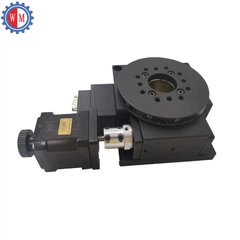
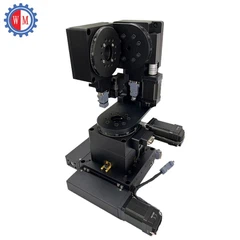


The world of precision engineering thrives on versatility and adaptability, especially when it comes to manual XY - axis stages. As a supplier deeply entrenched in this industry, I've witnessed firsthand the diverse needs of our clients, which has led to the development of a wide range of configurations for manual XY - axis stages. In this blog, we'll explore the various configurations available and how they can meet different application requirements.
Fundamental Configurations of Manual XY - Axis Stages
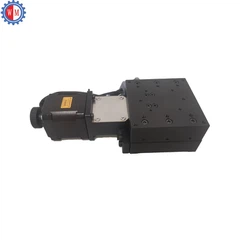
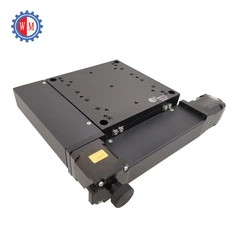
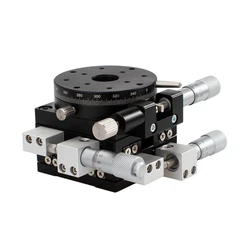
At the heart of manual XY - axis stages, there are several distinct configurations that are designed to deliver precise movement and positioning. One of the most common configurations is the stacked stage setup. In this configuration, two linear translation stages are stacked perpendicularly on top of each other. The lower stage provides motion in the X - axis, while the upper stage offers movement in the Y - axis. This setup allows for independent control of movement in the two orthogonal directions, enabling users to accurately position objects in a two - dimensional plane.
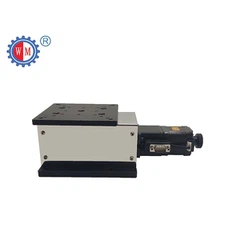
For example, the XY Manual Linear Translation Stage features a sturdy and well - engineered stacked design. The precision - ground guideways ensure smooth and stable motion, while the fine - pitch lead screws provide accurate position adjustment. This type of stage is particularly useful in applications where high - resolution positioning is required, such as in microscopy, optical alignment, and small - scale manufacturing processes.
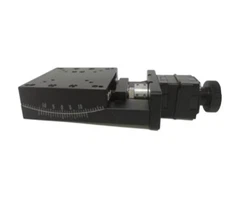
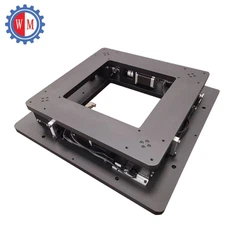
Another important configuration is the integrated stage. In an integrated manual XY - axis stage, the X and Y motion mechanisms are incorporated into a single unit. This design offers a more compact and streamlined solution compared to the stacked stage. The integrated stage is often favored in applications where space is limited, such as in portable measurement devices or small - scale laboratory setups.
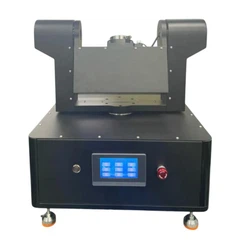
The Manual Optical Alignment Stage is a prime example of an integrated configuration. It is specifically engineered for precise optical alignment tasks. The stage's compact size and high - precision movement capabilities make it ideal for aligning optical components, such as lenses, mirrors, and fiber optics. The integrated design not only saves space but also reduces the complexity of the setup, making it easier for users to handle and operate.
Customizable Features for Different Applications
Beyond the basic configurations, manual XY - axis stages can also be customized with various features to meet specific application requirements. One of the key customizable features is the travel range. Different applications may require different amounts of movement in the X and Y axes. For instance, in some large - scale manufacturing processes, a long travel range is needed to accommodate the movement of large workpieces. On the other hand, in micro - scale research and testing, a shorter but more precise travel range may be sufficient.
As a supplier, we offer a wide range of travel ranges for our manual XY - axis stages. Whether you need a stage with a travel range of just a few millimeters or one that can cover several hundred millimeters, we can provide a solution that meets your needs. This flexibility allows our customers to choose the most suitable stage for their specific applications, ensuring optimal performance and efficiency.
Another important customizable feature is the resolution. Resolution refers to the smallest increment of movement that the stage can achieve. High - resolution stages are essential in applications where extremely precise positioning is required, such as in semiconductor manufacturing and nanotechnology research. Our Manual XY Motion Stage can be customized to have different resolutions, depending on the customer's requirements. By using high - precision lead screws and encoder systems, we can achieve resolutions as fine as a few micrometers or even nanometers in some cases.
In addition to travel range and resolution, the load capacity of the stage is also a crucial factor to consider. Different applications may involve different weights of objects to be moved and positioned. For heavy - duty applications, such as in industrial automation or large - scale material testing, a high - load - capacity stage is required. Our manual XY - axis stages are available in a variety of load capacities, ranging from a few kilograms to several hundred kilograms. This ensures that we can provide a stage that can handle the specific load requirements of each application.
Material and Construction Considerations
The choice of materials and construction methods also plays a significant role in the performance and durability of manual XY - axis stages. Most of our stages are constructed using high - quality metals, such as aluminum and steel. Aluminum is a popular choice due to its lightweight and corrosion - resistant properties. It is often used in applications where portability and ease of handling are important, such as in field - based measurement and testing.
Steel, on the other hand, is known for its high strength and rigidity. Stages made of steel are more suitable for heavy - duty applications that require high load - bearing capacity and excellent stability. The guideways and lead screws of our stages are also carefully designed and manufactured to ensure smooth and accurate motion. High - precision grinding and machining processes are used to achieve tight tolerances, which contribute to the overall performance of the stage.
The surface finish of the stage is another important consideration. A smooth and flat surface finish can reduce friction and wear, improving the efficiency and lifespan of the stage. Our stages are finished with high - quality coatings to protect the surface from corrosion and damage, ensuring long - term reliability and performance.
Applications in Various Industries
Manual XY - axis stages find applications in a wide range of industries, each with its own unique requirements. In the semiconductor industry, these stages are used for wafer inspection, die bonding, and lithography processes. The high precision and repeatability of our stages are essential for ensuring the quality and accuracy of semiconductor manufacturing.
In the optical industry, manual XY - axis stages are used for optical component alignment, fiber optic coupling, and laser beam positioning. The Manual Optical Alignment Stage is specifically designed to meet the demanding requirements of optical applications, providing precise and stable positioning for optical elements.
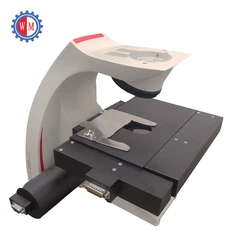
In the medical and biotechnology fields, these stages are used for microscopy, cell manipulation, and drug discovery. The ability to precisely position samples and instruments is crucial for accurate analysis and experimentation.
In the research and development sector, manual XY - axis stages are widely used for a variety of experiments and testing. Their versatility and ease of use make them an ideal choice for scientists and researchers who need to perform precise positioning tasks in a laboratory environment.
Conclusion
In conclusion, manual XY - axis stages are available in a wide range of configurations, each designed to meet specific application requirements. Whether you need a simple stacked stage for basic positioning tasks or a highly customized stage with specific travel range, resolution, and load capacity, we can provide a solution that meets your needs. Our commitment to quality, precision, and versatility has made us a trusted supplier in the industry.

If you're in the market for a manual XY - axis stage, we invite you to contact us to discuss your specific requirements. Our team of experts will be happy to assist you in selecting the most suitable stage for your application and guide you through the procurement process. We look forward to the opportunity to work with you and help you achieve your precision engineering goals.
References
- "Precision Motion Control Handbook", John Wiley & Sons
- "Optical Engineering Fundamentals", SPIE Press
- Industry whitepapers on manual XY - axis stages technology and applications.


